



Your electrical panel sits in a garage, laundry room, or closet and does its job quietly for decades — until it doesn’t. Here’s the reassuring part: in our experience, panels almost always warn you before they fail. You just have to know what the warnings look like.
These are the seven signs we see most often in homes around New Port Richey, and what we’d tell you about each one if we were standing in front of your panel together.
Safety first: If you smell burning, see scorch marks, or your panel is hot to the touch, don’t wait — call a licensed electrician right away at 727-457-8797. These can indicate an active hazard.
1. Your breakers trip — a lot
A breaker that trips once in a blue moon is doing its job. A breaker that trips every time you run the microwave and the toaster together is telling you something: the circuit is overloaded, or the breaker itself is wearing out.
Occasional trips are normal. Frequent, predictable trips are a warning. If resetting breakers has become part of your weekly routine, your panel is struggling to keep up with your home’s demand. That’s the panel talking to you — listen to it.
2. You smell burning or see scorch marks
This is the one to take seriously. A faint burning or “hot plastic” smell near the panel, discolored or scorched breaker switches, or melted insulation on wires are signs of overheating connections. And overheating connections are how electrical fires start. Full stop.
Don’t ignore this. Turn off the affected circuit if you can do so safely, don’t touch anything inside the panel, and call a licensed electrician the same day. When a homeowner calls us with this symptom, we treat it as urgent — because it is.
3. The panel is 25+ years old (or a known problem brand)
Electrical panels don’t last forever. If yours is 25 years or older, its components are likely past their reliable service life. And some older panels — notably certain Federal Pacific (FPE) and Zinsco models — have documented failure rates. The breakers in some of these may not trip when they should, which defeats the entire purpose of having them.
We still find FPE and Zinsco panels in the older ranch homes around New Port Richey. Often the homeowner has lived with one for decades without knowing what it is. Not sure what you have? The brand name is printed on the panel door. If you see Federal Pacific or Zinsco, get it evaluated — replacement is strongly recommended by most electricians and many insurers. In our view, this isn’t a “maybe someday” item.
4. The panel feels warm — or hot
Here’s a quick test anyone can do: put the back of your hand near (not on) the panel door. Warm is borderline. Hot is an emergency. Heat means resistance somewhere in the connections, and resistance means energy turning into heat instead of flowing safely to your outlets.
A hot panel should be looked at immediately. This is not a “we’ll get to it next month” situation — it’s a “call today” one.
5. Lights flicker or dim when appliances kick on
Lights that dip every time the AC compressor starts are a classic sign of an undersized or aging panel. In Florida this is especially common — air conditioners put brutal seasonal demand on the system, and a panel that was fine in March can start showing its age by August. It can also indicate loose connections or a failing main breaker, which are worth catching early.
One flickering bulb is usually just a bulb. Whole-room dimming tied to appliances is a panel conversation.
6. You see rust or corrosion
Panels live in garages and utility rooms, and Florida humidity is relentless — it eats metal. Rust on the panel box, corrosion on breakers, or moisture inside the enclosure all degrade connections over time. And corroded connections overheat.
If your panel shows visible rust, it has been compromised. Corrosion doesn’t reverse itself, and it only gets worse. We see this a lot in panels mounted in unconditioned garages, where the summer heat and humidity do their worst.
7. You’re out of space — or about to add big loads
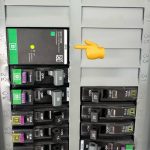
Running out of breaker slots is your panel’s polite way of saying it’s undersized. Planning to add an EV charger, a hot tub, a home addition, or a workshop? Those need real capacity — not a tandem breaker squeezed into a full panel as a workaround.
A proper 200-amp service handles the demands of a modern Florida home comfortably. If your panel is maxed out, an upgrade isn’t optional — it’s the only safe way to add load. Any electrician who tells you otherwise is cutting a corner.

What a panel replacement involves
For most New Port Richey homes, a panel upgrade is a one-day job:
- Assessment — we inspect your panel, service size, and wiring, and we tell you honestly whether you need a full replacement or a simpler fix.
- Permit — we pull the required Pasco County permit for you.
- Replacement — power is off for a few hours while we swap the panel.
- Inspection — the county inspects and signs off on the work.
Typical cost range: $1,500–$4,000 depending on amperage, panel location, and any wiring corrections needed. For a detailed breakdown, see our guide to the typical cost of a panel upgrade in the New Port Richey area. We’ll give you an exact written quote before any work begins.
One more thing worth knowing: a panel swap is not where you want anyone learning on the job. At Reliant, panel upgrades are handled by our most experienced electricians — the seasoned techs, not apprentices sent out to figure it out. They’ve opened hundreds of panels across this area. They know where the aluminum wiring hides in the older block homes, how to work cleanly around a live service drop, and how to get your power back on the same day without drama. That experience matters more on this job than on almost any other.
Frequently asked questions
How do I know if my electrical panel is dangerous?
The clearest danger signs are a burning smell, scorch marks, a hot panel, or breaker trips that keep getting worse. Older Federal Pacific or Zinsco panels are also considered high-risk by most electricians. When in doubt, have a licensed electrician inspect it — or schedule an electrical safety inspection with our team. An inspection is far cheaper than a fire, and it buys you peace of mind either way.
How long does an electrical panel last?
Most panels last 25–40 years. Breakers can wear out sooner, especially in Florida’s heat and humidity, which ages components faster than in milder climates. If your panel is past 25 years, have it evaluated even if nothing seems wrong — age alone is reason enough.
Can I replace an electrical panel myself?
No — panel replacement requires a permit, a utility disconnect, and licensed expertise. It’s also illegal for unlicensed individuals in Florida. This is firmly a job for a licensed electrician, and frankly, it’s the kind of job where you want the experienced one.
Will a new panel lower my electric bill?
Not directly — a panel doesn’t use electricity, it distributes it. But an upgrade lets you safely add efficient systems (like a modern HVAC or EV charger) and eliminates the energy waste of overheating connections.
Does homeowner’s insurance care about my electrical panel?
Yes. Many insurers ask about panel brand and age, and some won’t write or renew policies on homes with Federal Pacific or Zinsco panels. Upgrading can genuinely help with insurability — we’ve had homeowners call us specifically because their insurer flagged the panel.
Seeing any of these warning signs? Don’t wait for a small problem to become a dangerous one. Call Reliant Electrical Inc. at 727-457-8797 for a professional panel evaluation and a clear written quote — or contact us for a free panel evaluation online. Licensed and insured, Florida license #EC13016013.